The Best Blinds for Auckland’s Humidity and Coastal Homes
Auckland asks more of a blind than most of New Zealand. We’re humid most of the year, half the city is within a few kilometres of salt water, and our houses run steamy bathrooms and open-plan kitchens. Here’s what survives that, and what quietly falls apart.
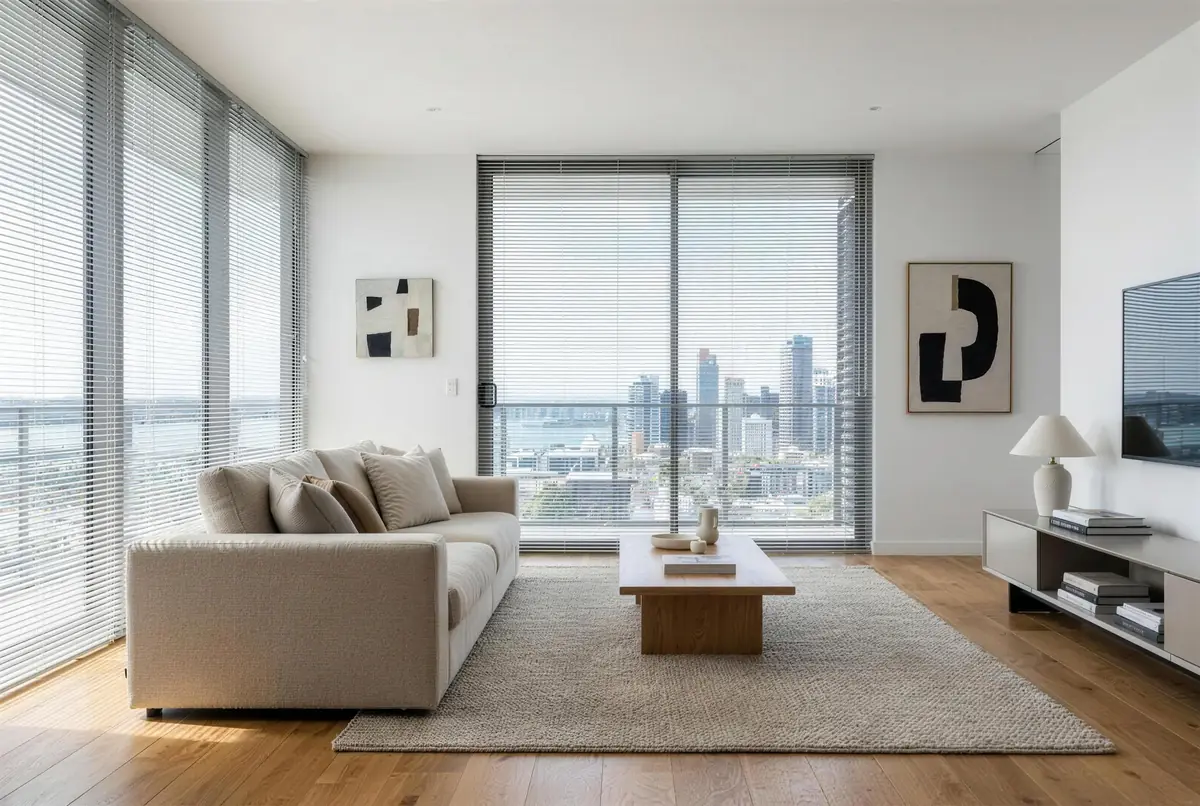
Most blinds fail in damp rooms for one of three reasons: the material swells, the material corrodes, or the fabric grows something you don’t want growing on it. Auckland manages to offer all three conditions, often in the same house.
The good news is that this is a solved problem. It just means matching the material to the room rather than picking one blind for the whole house.
What Auckland actually does to a blind
Humidity. Auckland sits at high relative humidity for much of the year. Real timber responds to that by taking on and giving off moisture, which is what makes it move. In a dry living room that movement is negligible. Above a shower or a hob, over years, it isn’t.
Salt. If you’re on the Shore, out east through Bucklands Beach and Howick, or anywhere west facing the Manukau, there is salt in the air that lands on everything. Salt is what turns unprotected metal chalky and stiff.
Steam and splashes. A bathroom without an extractor fan running is a small cloud. A kitchen blind near a hob catches oil as well as water, which is the combination that makes pale fabrics look grubby faster than anyone expects.
The single most common mistake we see: one fabric or material chosen for the whole house because it looked good in the living room, then quietly failing in the two wet rooms.
Kitchens: aluminium or faux wood venetians
Aluminium venetians are the safest choice near a hob or sink. They won’t warp, swell or rot, the slats wipe clean in seconds, and the powder-coated finish holds its colour. They come in 16mm or 25mm slats, so you can keep them slim in a smaller window.
Faux wood venetians do the same job with the look of painted timber. If you want the presence of a wood blind in a kitchen without the risk, this is the way to get it.
One practical tip on colour: in a kitchen, a mid or darker tone will look clean far longer than a bright white. Cooking film settles on everything, and it shows worst on pale surfaces.
Bathrooms and laundries: aluminium
Small windows, constant steam, not much airflow. Aluminium handles it and stays easy to clean. Real timber — including cedar and custom-painted timber — is the wrong call here no matter how good it looks, and we’ll say so at the measure rather than sell you one.
Coastal living rooms: sunscreen rollers
Salt air is hard on materials, but the bigger issue in a coastal home is usually light. A west-facing living room over the water gets glare that makes the TV unwatchable and fades furniture and flooring over time.
Sunscreen roller blinds are the answer, because they solve the glare without taking away the reason you bought the house. The open weave cuts UV and softens the sun while you keep the outlook. On a strong western aspect, choose a darker screen colour — counter-intuitive, but a dark screen cuts glare noticeably better than a pale one.
Bedrooms: blockout, and mind the edges
Blockout rollers are standard for bedrooms anywhere. The humidity-specific note is about fitting rather than fabric: in a room that gets damp, a face-fitted blind that sits proud of the window has more air moving around it than one crammed into a tight recess. We’ll look at that per window.
What we’d avoid, and why
- Real timber in wet rooms. Cedar is a beautiful blind and a poor bathroom blind. It belongs in living rooms, bedrooms and character spaces.
- Untreated metal fittings on coastal windows. Salt finds them. Powder-coated components are worth it within sight of the sea.
- Pale fabrics directly above a hob. They work, they just stop looking new sooner than you’d like.
- One choice for the whole house. Mixing materials across an order costs nothing extra and it’s what a house in this climate actually needs.
A realistic whole-house setup
For a typical Auckland home with a damp bathroom, a working kitchen and a view worth keeping, the mix that comes up most often is: aluminium venetians in the bathroom and laundry, aluminium or faux wood in the kitchen, sunscreen rollers through the living areas, and blockout rollers in the bedrooms. Cedar or custom-painted timber wherever the room is dry and the look matters.
That’s four different products in one house, which sounds fussy until you remember each one is doing a different job.
Keeping them right once they’re up
Aluminium and faux wood wipe down with a damp cloth. Timber prefers a dry dust or a barely-damp cloth — don’t soak it. In a coastal home, an occasional wipe of the fittings matters more than the fabric, because that’s where salt sits. There’s more detail on our care and cleaning page.
If something has already gone wrong — a seized roller mechanism, cracked venetian slats — that’s often repairable rather than replaceable. See blind repairs.
Not sure what suits your rooms?
We come to you anywhere in Auckland, look at every window, and tell you honestly which material belongs where. Free measure and quote, no obligation.
Book my free measure →