The Best Blinds for Bedrooms
Almost every bedroom conversation we have comes down to one question: how dark can you actually get it? Here’s the honest answer, including the part most people only discover after the blinds are up.
Start with what the room is for
A bedroom blind has three jobs, and they pull against each other: darkness for sleeping, privacy at night, and something you don’t mind looking at during the day. A shift worker’s bedroom and a guest room with a harbour view need different answers.
So before the product, the question worth settling is how much darkness you actually need. There’s a real difference between “dim enough to sleep” and “dark enough that a baby naps at 2pm in January”.
Blockout rollers: the default, and why
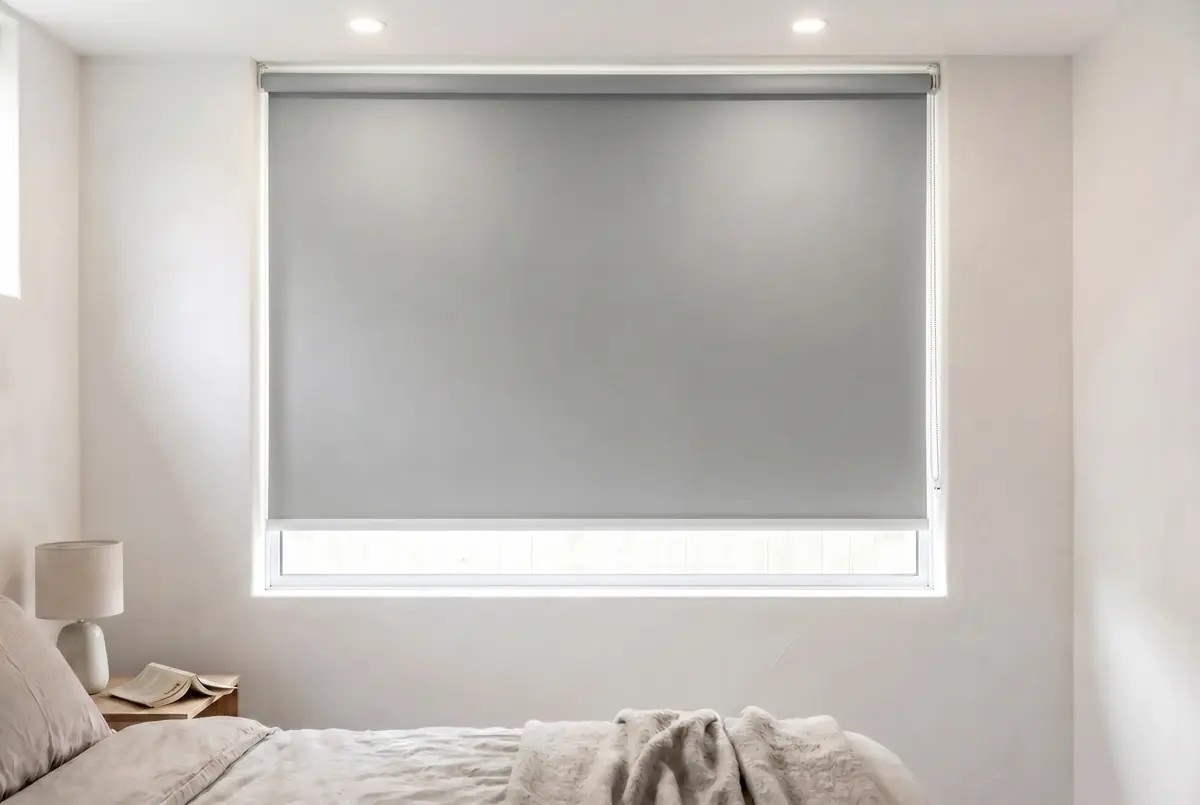
Blockout roller blinds are what we fit in most Auckland bedrooms. The fabric is coated so no light passes through the weave itself — not filtered, stopped. You get full privacy day and night, a clean flat look that suits modern joinery, and a bit of extra insulation at the glass, which matters in an older Auckland house with single glazing.
They’re also the simplest thing in the room. One sheet of fabric, one tube, very little to go wrong.
The bit nobody mentions in the showroom: the fabric blocks essentially all light, but light still comes around the edges of the blind. That gap is where bedroom darkness is won or lost, and it’s a fitting decision, not a fabric one.
How to actually get a dark room
If genuine darkness is the goal, these are the levers, roughly in order of how much difference they make:
- Face-fit rather than recess-fit. Mounting the blind on the wall above the window, overlapping the opening on both sides, cuts the side gap dramatically. A blind fitted neatly inside the recess will always leave a line of light down each edge.
- Go wider than the window. Where there’s wall to play with, extra width either side does more for darkness than any fabric upgrade.
- Mount higher. Lifting the bracket above the window head reduces the light spill over the top of the blind.
- Pair with curtains. A blockout roller behind curtains is the belt-and-braces version, and it’s common in bedrooms where someone genuinely can’t sleep with any light.
We look at all of this at the measure, per window, because it depends on your architrave, your sill depth and how much wall you’ve got.
Dual rollers: for bedrooms with a view
If the bedroom looks at something worth looking at, a dual roller is the one to consider. It puts a sunscreen and a blockout on the same bracket: sunscreen down through the day so you keep the outlook and lose the glare, blockout down at night for total darkness and privacy.
It costs more than a single blind because it is two blinds. On a street-facing bedroom or one with a harbour outlook, it’s usually the one people are happiest with a year later.
What about venetians in a bedroom?
They look excellent and they don’t darken a room. Closing the slats gives you full privacy, but light still passes where the slats meet. Cedar or custom-painted timber venetians in a bedroom are a style choice, and a good one in a villa or a character room — just don’t expect them to do a blockout’s job.
Plenty of Auckland homes end up with venetians through the living areas and blockout rollers in the bedrooms, which is a perfectly sensible way to do it.
Nurseries and kids’ rooms
Daytime sleeps are the whole game here, so this is where face-fitting and overlap earn their keep. Blockout fabric, fitted wide, is what makes a 2pm nap possible in a New Zealand summer.
If you’d rather have no chain in the room at all, a motorised roller removes it entirely and runs off a handheld remote.
Operation: chain or motor
A continuous chain is simple, reliable and what most bedrooms get. Motorisation is worth thinking about on a high window, a wide window, or anything above a stairwell — the places where reaching the blind is a nuisance every single day. You can run a whole room from one remote.
Colour, briefly
Darker fabrics read as cosier and hide marks. Lighter fabrics keep a small room feeling bigger and bounce more daylight around when the blind is up. Neither affects how dark the room goes — that’s the coating, not the colour — so choose on looks. Our blockout range runs from soft whites through to deep charcoals, and you can see every colour on the blockout page.
What it comes with
Every made-to-measure roller blind we make carries a five-year warranty, and most roller orders are made in less than two weeks. They’re made in our own Auckland factory and we install right across the region — or we’ll supply anywhere in New Zealand if you’re measuring yourself, in which case start with our how to measure guide.
Want the bedroom genuinely dark?
Book a free in-home measure. We’ll look at each window, work out where the light is getting in, and quote it properly.
Book my free measure →